
6th July 2026
Betplay Capital Foundation
ZJ Foundation Fundacja Rodzinna
MJ Foundation Fundacja Rodzinna
(the Juroszek family investment foundations)
c/o Betplay Capital, ul. Porcelanowa 10
40-246 Katowice
Poland
The Board of Directors
DigiPlus Interactive Corp.
Ecoprime Building, 32nd Street corner 9th Avenue
Bonifacio Global City, Taguig City, 1635
Philippines
Dear Respected Members of the Board of Directors,
We are writing to you on behalf of the Juroszek family investment foundations – Betplay Capital Foundation, ZJ Foundation and MJ Foundation. We are investors strictly connected with a iGaming sector, with deep experience on both the operating and investment sides of the industry: our family founded and for many years owned the largest sports-betting operator in Poland, and we run Betplay Capital, an investment fund dedicated exclusively to the global gaming and digital entertainment sector. We have been shareholders of DigiPlus Interactive Corp. for approximately two and a half years, we currently hold approximately 1.4% of the company, and – at current prices – we continue to increase our position. We remain highly encouraged by the development of the business and firm believers in its long-term potential.
Over the period of our ownership, the operational progress we have witnessed has been truly remarkable. DigiPlus has established itself as the clear leader of digital entertainment in the Philippines, with BingoPlus, ArenaPlus and GameZone becoming household names. Even after a very difficult year, first-quarter 2026 revenue of around PHP 17.2 billion still stands roughly four times above the PHP 4.2 billion generated in the first quarter of 2023, and about 27% above the PHP 13.6 billion of the first quarter of 2024, with EBITDA and net income over the same three-year period multiplying several times over. This is an extraordinary record of value creation, and we would like to thank the Board, the management and the employees for making it happen.
Our recommendation, in brief
We will set out our reasoning in full below, but we want to state our central message up front. In our view the single most value-accretive action available to DigiPlus today is a substantial share repurchase, executed consistently at current prices, funded from the company’s own cash generation and, where sensible, in place of deferrable capital expenditure. The shares are so far below any reasonable estimate of fair value that buying them back is worth more to shareholders than any other use of that capital we can identify. We are also conscious that the repurchase authorization the Board approved a year ago is due to expire on 4 July 2026 and will require renewal by the Board, which we would likewise strongly encourage. Everything that follows is an attempt to demonstrate why.
A heavily tested but fundamentally intact business
We are fully aware that the past twelve months have tested the company severely. The delinking of e-wallet in-app access from licensed online gaming platforms disrupted user activity and transaction flows through 2025 and created an exceptionally demanding comparison base, while 2026 opened with an external macro shock, as the war in Iran triggered a global fuel crisis and tempered consumer sentiment across the region. It is important to stress that neither of these headwinds reflects any deterioration in the competitive position, the product, or the economics of DigiPlus itself. The company has responded exactly as a market leader should: adapting its payments ecosystem, reducing reliance on third-party access points, and continuing to expand its offering. Revenue has already stabilized sequentially, the balance sheet remains a fortress with over PHP 20 billion of cash and virtually no debt, and as these transitory pressures normalize, we expect the return to growth in 2027 to bring the company’s trading multiples back towards industry standards.
A highly compelling valuation disconnect versus industry peers
What the market has done to the valuation in the meantime is, in our view, simply absurd. The exhibits below compare DigiPlus with the global universe of listed B2C gaming operators, and the picture they paint is unambiguous: DigiPlus currently trades as the lowest-valued B2C operator in the entire peer group across every major valuation metric, and by a wide margin.
On EV/EBITDA for 2026E (consensus), DigiPlus trades at around 2.4x, roughly a third of the peer median and a fraction of the multiples awarded to comparable operators (Exhibit 1). On EV/Sales, the shares change hands at around 0.4x, against a peer median of approximately 1.5x (Exhibit 2). And on free cash flow yield, DigiPlus offers around 32% for 2026E – the highest in the entire peer group, and more than six times the peer median of roughly 5% (Exhibit 3).
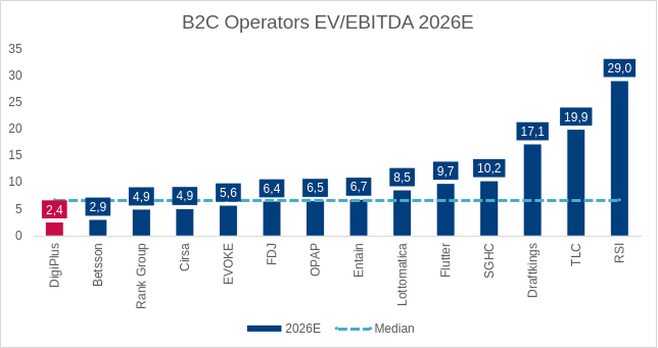
Exhibit 1: B2C operators EV/EBITDA 2026E – DigiPlus vs listed peers [*Numbers as of 02.07.2026]
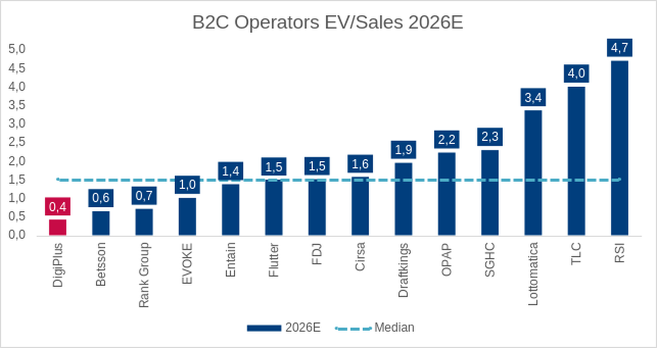
Exhibit 2: B2C operators EV/Sales 2026E – DigiPlus vs listed peers [*Numbers as of 02.07.2026]
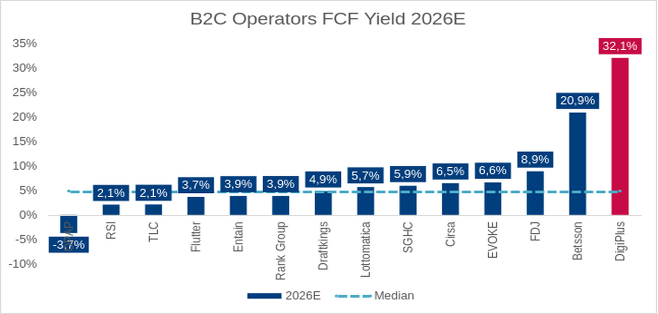
Exhibit 3: B2C operators free cash flow yield 2026E – DigiPlus vs listed peers [*Numbers as of 02.07.2026]
One could argue that a discount is justified for a business with inferior growth. The opposite is true here. When the peer group multiples are plotted against expected growth, DigiPlus sits far below the regression line: the market awards it the lowest EV/EBITDA multiple in the group despite EBITDA growth expectations for 2027 of close to 20%, well above most peers (Exhibit 4), and the lowest EV/Sales multiple despite double-digit expected sales growth (Exhibit 5). In other words, the current valuation cannot be explained by fundamentals, growth, balance sheet or cash generation – it is a pure sentiment discount, and sentiment discounts do not last.
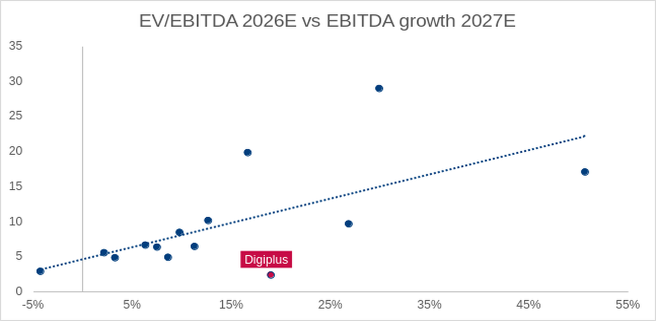
Exhibit 4: EV/EBITDA 2026E vs expected EBITDA growth 2027E – DigiPlus far below the peer regression line [*Numbers as of 02.07.2026]
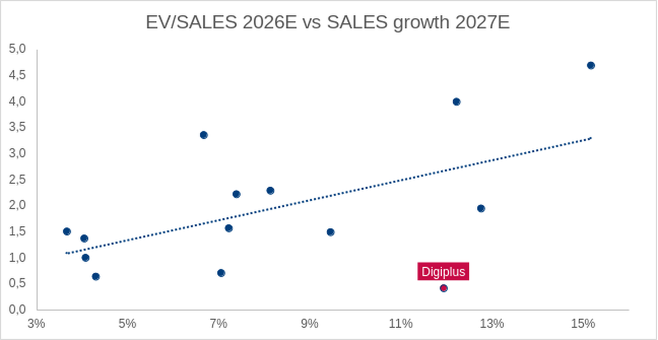
Exhibit 5: EV/Sales 2026E vs expected sales growth 2027E – DigiPlus far below the peer regression line [*Numbers as of 02.07.2026]
What the industry multiples imply – a simple re-rating upside
It is worth translating this discount into a concrete number. Applying the peer group’s own median multiples – on EV/EBITDA, EV/Sales and P/E, for both 2026E and 2027E – to DigiPlus’s own financials produces an average implied valuation of roughly PHP 30 per share (Exhibits 6 and 7). Against a recent market price in the low-teens, that is more than 150% upside, and it requires no heroic assumptions whatsoever: no new markets, no margin expansion beyond consensus, no premium rating. It is simply what DigiPlus would be worth if the market stopped applying a punitive discount and priced it in line with the median of its own peer group. On the individual metrics, DigiPlus currently trades at a discount of roughly two-thirds to that peer median (Exhibit 6).
This is the core of our argument.. The upside here does not depend on the company doing anything extraordinary – it depends only on the abnormal sentiment discount fading as the delinking and macro headwinds normalize. A buyback executed today captures that gap twice over: it retires shares while the discount persists, and it amplifies the per-share benefit of the eventual re-rating. Put simply, the company can buy its own future re-rating at a two-thirds discount.
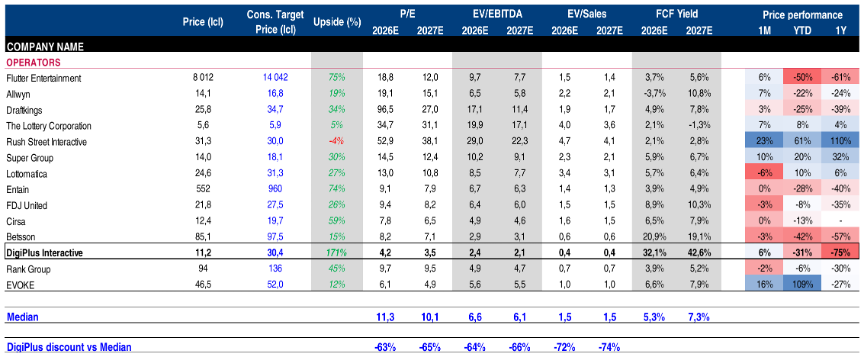
Exhibit 6: DigiPlus valuation on B2C peer operator multiples – per-metric implied price and discount to peer median [*Numbers as of 02.07.2026]
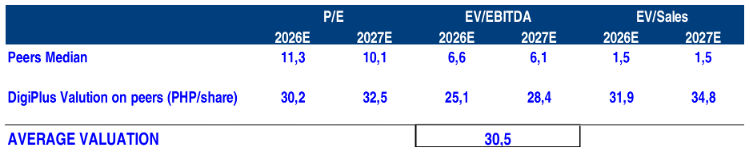
Exhibit 7: Summary: DigiPlus valuation on peer median multiples (PHP per share) – average of roughly PHP 30 [*Numbers as of 02.07.2026]
This brings us back to our central recommendation. It is with the evidence above in mind that we urge the Board to pursue a substantial share buyback program at current prices, which we believe is by far the greatest value creation opportunity available to shareholders today. Our reasons are threefold:
- No other use of capital comes close to repurchasing the company’s own shares: at around 2.4x EV/EBITDA and 0.4x EV/Sales for 2026E, the company trades at roughly one-third of the peer median (Exhibits 1 and 2), while offering a free cash flow yield of around 32% – the highest in the peer group (Exhibit 3). We know of no acquisition, no capex project and no new venture available to the company that offers a comparably high, low-risk return. Every share repurchased and canceled at these levels is permanently and materially accretive for every shareholder who stays on.
- The balance sheet already gives the company all the firepower it needs: the business is asset-light at its digital core, holds over PHP 20 billion of cash against negligible debt, and converts profits into cash at a rate its peers can only envy, as the free cash flow yield comparison shows. The dividends already paid demonstrate the company’s capacity to return capital; a buyback at a c. 32% free cash flow yield is simply a far more accretive use of the same cash while the shares trade at these levels.
- Further land-based investments are not optimal at this stage and can be deferred: we understand the strategic logic of the land-based and integrated resort ambitions. However, land-based projects are capital-heavy, carry long payback periods, and their returns cannot realistically compete with buying back the company’s own stock at one-third of the industry multiple. Our respectful suggestion is that any non-committed land-based capital expenditure be postponed, and that in the meantime, the entire free cash flow be redirected towards buying back and canceling shares. The land-based opportunities are likely to remain available in the future; the current share price dislocation may not.
What a consistent repurchase would achieve
- Increasing earnings and free cash flow per share, simply because there are fewer shares outstanding;
- Demonstrating to the market that the company generates significant cash and is ready to return capital to shareholders;
- Sending a positive signal that the Board itself believes the current discount to industry peers does not make sense;
- Creating an additional source of market demand, as the company becomes an active buyer of its own shares;
- Returning capital in a more tax-efficient way than dividends: a buyback delivers value to continuing shareholders through a lower share count and higher earnings and free cash flow per share, without triggering the withholding tax that applies to cash dividends. Shareholders are taxed only if and when they choose to sell, rather than on every distribution – so more of each peso deployed reaches shareholders rather than the tax authority.
Capital allocation and the long-term compounding case
From our experience, a company with good capital allocation will always trade at a better long-term multiple. The use of cash should be balanced between growing the business and paying back shareholders – but the balance must reflect the price at which the market values the company. At one-third of the peer group multiple and a c. 32% free cash flow yield, the balance points overwhelmingly towards the buyback.
The beauty of acting now is in the arithmetic. Every year of free cash flow deployed into buybacks at current prices can retire a meaningful portion of the entire share count. The headwinds of the past year – the e-wallet delinking and the fuel-crisis shock to consumer sentiment – are transitory, and the comparison base they created is low. When conditions normalize and the business returns to growth in 2027, as we firmly expect it to, DigiPlus should no longer trade at 2.4x EV/EBITDA while its peers command 5–10x and more; a mere convergence towards the peer median – applied to higher earnings spread over a reduced share base – implies a share price at a multiple of today’s level. Shares repurchased and canceled in the meantime will prove to have been bought at once-in-a-cycle prices.
We are pleased to be shareholders of DigiPlus. We truly enjoy the journey of watching the company become the champion of digital entertainment in the Philippines and beyond, and we believe the steps outlined above would turn the current market pessimism into a historic opportunity for all shareholders who stay on.
Thank you for your time and attention, and we hope you find our recommendations helpful.
Sincerely,
Tomasz Juroszek
For and on behalf of Betplay Capital Foundation, ZJ Foundation, and MJ Foundation
c/o Betplay Capital, ul. Porcelanowa 10, 40-246 Katowice, Poland